

1980


Curators' Team
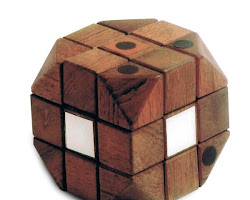
Rubik's Cube
Ernő Rubik, a Hungarian architect and teacher in Budapest, built his first working prototype in 1974 as a teaching aid for understanding three dimensional movement. Some sources date the invention to 1975, which is the year he applied for a Hungarian patent in January. He called the puzzle the Magic Cube, and the first test batches reached Budapest toy shops in late 1977. One source says about 300,000 had sold inside Hungary by 1979.
The puzzle left Hungary because of a chain of introductions. Tibor Laczi carried a sample to the Nuremberg Toy Fair in February 1979, where Tom Kremer of the London firm Seven Towns noticed it. In September 1979, Seven Towns and Rubik's Hungarian partners signed a deal with the Ideal Toy Corporation to sell the puzzle worldwide.
Ideal considered names such as The Gordian Knot and Inca Gold before settling on the inventor's surname. One account adds that the old name was dropped partly because Magic Cube suggested witchcraft to some buyers. The Nuremberg visit came roughly a year before the public debut, so the puzzle spent about twelve months in negotiation and preparation before shoppers outside Hungary could buy it. Ideal's worldwide debut came at toy fairs in London, Paris, Nuremberg, and New York in January and February 1980, and the first shipment left Hungary in May of that year. No source documents a single launch day for those fairs.
Sales were modest at first, then climbed after Ideal began television advertising in the middle of 1980, and by the end of that year the puzzle had won toy awards in Germany, Britain, France, and the United States. The demand also attracted a wave of copies from other makers.
Sales totals vary by source. One estimate puts sales at about 100 million between 1980 and 1982, while another says about 200 million by 1983, and a frequently quoted figure of 350 million covers the years up to 2009. The fad cooled in the mid 1980s as buyers lost interest, but the puzzle never disappeared from stores. Interest later returned through speed solving communities, and the brand has stayed in production since then with new sizes and variations of the original design.
Source: Ideal Toy Co.


,
,
LOADING...


YEAR
YEAR
Item Year:
Item Year:
SOURCE
Item Year:
LOCATION
Item Year:
YEAR
LIVE LOUD
LIVE LOUD
YEAR
LIVE LOUD

LIVE LOUD