


SPACE EXPLORATION
SPACE EXPLORE

Space exploration is the use of rockets, satellites, probes and crewed spacecraft to study what lies beyond Earth. It began in earnest with Sputnik 1 in 1957 and has carried humans to orbit and the Moon, and robotic missions across the solar system.
SELECT/
UNSELECT
TO FILTER .REFRESH THE PAGE FOR REGULAR VIEW.


Beyond the Timeline
In 1942, Nazi Germany's V-2 rocket became the world's first long-range guided ballistic missile, reaching the edge of space at speeds up to 3,500 miles per hour, which laid the groundwork for modern rocketry and space exploration. In 1957, the Soviet Union launched Sputnik 1, the first artificial satellite to orbit Earth. It weighed 184 pounds and transmitted radio pulses back to Earth. This marked the beginning of the space age and demonstrated the possibility of sending objects into orbit.
In 1961, Soviet cosmonaut Yuri Gagarin made history as the first human to journey into outer space and orbit Earth aboard Vostok 1. His 108-minute flight proved that humans could survive and function in space, paving the way for future manned missions.
In 1969, a space task group recommended to President Richard Nixon a space program to follow the missions to the Moon. The plan included a permanently occupied space station, a reusable shuttle spacecraft, and eventual missions to Mars. However, these ideas received little political or public support due to rising budget pressures. Only the Space Shuttle won favor and funding, and even that decision was controversial. NASA's Apollo 11 mission, commanded by Neil Armstrong and piloted by Buzz Aldrin and Michael Collins, achieved the first manned Moon landing.
When the last two Apollo missions were canceled, NASA used some of the remaining hardware for an experimental space station. Skylab, the United States' first space station, was launched by NASA in 1973. Over its operational lifetime, it housed three separate crews that conducted various scientific and medical experiments and observations of the Sun and Earth. Skylab was in orbit from 1973 to 1979.Survival in space over a prolonged period requires extensive scientific and engineering support to address the unique challenges of space travel. Apollo 11's spacesuits were custom-made wearable spacecraft that cost an estimated $100,000 at the time, equivalent to over $670,000 today. It consisted of 21 layers of synthetics, neoprene rubber, and metalized polyester films, protecting Armstrong from the Moon's extreme temperatures (240°F in sunlight to -280°F in shadow), solar ultraviolet radiation, and micrometeorites. The suit allowed Armstrong to collect lunar samples, deploy experiments, and explore a crater.
Contracted by the National Aeronautics and Space Administration (NASA) in 1959, Pillsbury was tasked with creating food that would not crumble or spawn bacteria in space. Traditional food safety testing proved inadequate for such a project, so Pillsbury’s scientists applied NASA’s rigorous engineering standards to develop space foods. The application of intense standards led to the creation of the Hazard Analysis and Critical Control Point (HACCP) System, a food safety system still in use today. Whirlpool first served the United States government in 1960. It opened the Space Kitchen, a lab to develop kitchen appliances that function in zero gravity. The lab ultimately developed methods of preparing and storing food for NASA’s Gemini, Apollo, and Skylab programs.
Food engineering focuses on portability, nutritional density, and preservation. Taste perception is reduced in space by approximately 30%, making the development of palatable space food essential. Early missions relied on unappetizing semi-liquids, but advancements led to dehydrated, cube-shaped foods and innovations such as the spoon-bowl pack. Today, astronauts have a wider variety of options, including fresh food and the opportunity to influence their menu, with ongoing research exploring space gardening for self-sufficiency.
Cosmonaut Valentina Tereshkova became the first woman in space aboard Vostok 6 in July 1963, marking an important step towards gender equality. In 1966, the Soviet Union's Luna 9 was the first spacecraft to achieve a lunar soft landing and to transmit photographic data from the Moon's surface to Earth, preceding the U.S. Surveyor 1 by about 4 months.
In 1975, an American Apollo spacecraft docked with the Soviet Soyuz spacecraft in orbit, marking the first international human spaceflight. This mission symbolized a thaw in Cold War tensions and paved the way for future international cooperation in space exploration. The launch of Space Shuttle Columbia in 1981 marked the beginning of the Space Shuttle program, introducing a reusable spacecraft capable of carrying humans and cargo to and from space. The program enabled a wide range of missions, including satellite deployment, scientific research, and the construction of the ISS. It was directed by President Ronald Reagan, who committed to a permanently crewed space station, encouraged private sector space efforts, and fostered international space partnerships with both U.S. allies and the Soviet Union. Reagan saw outer space as humanity’s final frontier and an opportunity for global leadership. His optimism and belief in American exceptionalism guided a decade of U.S. space activities.
Human spaceflight is barely six decades old, and it has been shaped as much by its failures as by its triumphs. Since 1960, at least 21 astronauts and cosmonauts have died during missions or flight tests, and more than 160 ground and support personnel have been killed in launch accidents. Each disaster triggered investigations, redesigns, new safety rules, and the procedures that govern modern launches are, in large part, written in the failures that came before them.
On March 23, 1961, less than three weeks before Yuri Gagarin became the first human in space, a member of the first Soviet cosmonaut group died in a training accident. Valentin Bondarenko, 24, was in the final hours of a ten-day isolation experiment in a high-pressure oxygen chamber. He used an alcohol-soaked cotton swab to clean his skin, dropped it onto a hot electric hotplate, and the oxygen-rich atmosphere ignited instantly, setting his flight suit on fire. He died that day. The accident stayed secret for decades.
On January 28, 1986, seventy-three seconds into STS-51L, Challenger’s right solid rocket booster's field joint failed and the external tank ruptured. All seven crew members died. The launch was broadcast live, and it has been widely reported that roughly half of the US.
On February 1, 2003, Columbia, NASA's first space shuttle, had flown 27 successful missions over 22 years when it broke apart over Texas during re-entry, killing all seven crew members of STS-107.
Visit our YouTube channel for a timeline of all disasters.
Add a Title
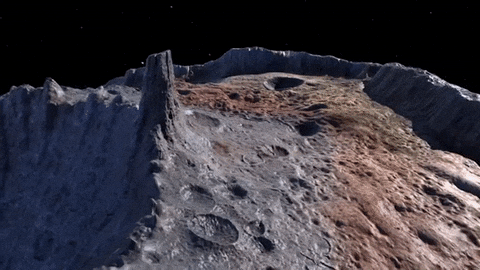
Space exploration is the use of rockets, satellites, probes and crewed spacecraft to study what lies beyond Earth. It began in earnest with Sputnik 1 in 1957 and has carried humans to orbit and the Moon, and robotic missions across the solar system.
SELECT/
UNSELECT
TO FILTER .REFRESH THE PAGE FOR REGULAR VIEW.
Beyond the Timeline
In 1942, Nazi Germany's V-2 rocket became the world's first long-range guided ballistic missile, reaching the edge of space at speeds up to 3,500 miles per hour, which laid the groundwork for modern rocketry and space exploration. In 1957, the Soviet Union launched Sputnik 1, the first artificial satellite to orbit Earth. It weighed 184 pounds and transmitted radio pulses back to Earth. This marked the beginning of the space age and demonstrated the possibility of sending objects into orbit.
In 1961, Soviet cosmonaut Yuri Gagarin made history as the first human to journey into outer space and orbit Earth aboard Vostok 1. His 108-minute flight proved that humans could survive and function in space, paving the way for future manned missions.
In 1969, a space task group recommended to President Richard Nixon a space program to follow the missions to the Moon. The plan included a permanently occupied space station, a reusable shuttle spacecraft, and eventual missions to Mars. However, these ideas received little political or public support due to rising budget pressures. Only the Space Shuttle won favor and funding, and even that decision was controversial. NASA's Apollo 11 mission, commanded by Neil Armstrong and piloted by Buzz Aldrin and Michael Collins, achieved the first manned Moon landing.
When the last two Apollo missions were canceled, NASA used some of the remaining hardware for an experimental space station. Skylab, the United States' first space station, was launched by NASA in 1973. Over its operational lifetime, it housed three separate crews that conducted various scientific and medical experiments and observations of the Sun and Earth. Skylab was in orbit from 1973 to 1979.
Survival in space over a prolonged period requires extensive scientific and engineering support to address the unique challenges of space travel. Apollo 11's spacesuits were custom-made wearable spacecraft that cost an estimated $100,000 at the time, equivalent to over $670,000 today. It consisted of 21 layers of synthetics, neoprene rubber, and metalized polyester films, protecting Armstrong from the Moon's extreme temperatures (240°F in sunlight to -280°F in shadow), solar ultraviolet radiation, and micrometeorites. The suit allowed Armstrong to collect lunar samples, deploy experiments, and explore a crater.
Contracted by the National Aeronautics and Space Administration (NASA) in 1959, Pillsbury was tasked with creating food that would not crumble or spawn bacteria in space. Traditional food safety testing proved inadequate for such a project, so Pillsbury’s scientists applied NASA’s rigorous engineering standards to develop space foods. The application of intense standards led to the creation of the Hazard Analysis and Critical Control Point (HACCP) System, a food safety system still in use today. Whirlpool first served the United States government in 1960. It opened the Space Kitchen, a lab to develop kitchen appliances that function in zero gravity. The lab ultimately developed methods of preparing and storing food for NASA’s Gemini, Apollo, and Skylab programs.
Food engineering focuses on portability, nutritional density, and preservation. Taste perception is reduced in space by approximately 30%, making the development of palatable space food essential. Early missions relied on unappetizing semi-liquids, but advancements led to dehydrated, cube-shaped foods and innovations such as the spoon-bowl pack. Today, astronauts have a wider variety of options, including fresh food and the opportunity to influence their menu, with ongoing research exploring space gardening for self-sufficiency.
Cosmonaut Valentina Tereshkova became the first woman in space aboard Vostok 6 in July 1963, marking an important step towards gender equality. In 1966, the Soviet Union's Luna 9 was the first spacecraft to achieve a lunar soft landing and to transmit photographic data from the Moon's surface to Earth, preceding the U.S. Surveyor 1 by about 4 months.
In 1975, an American Apollo spacecraft docked with the Soviet Soyuz spacecraft in orbit, marking the first international human spaceflight. This mission symbolized a thaw in Cold War tensions and paved the way for future international cooperation in space exploration. The launch of Space Shuttle Columbia in 1981 marked the beginning of the Space Shuttle program, introducing a reusable spacecraft capable of carrying humans and cargo to and from space. The program enabled a wide range of missions, including satellite deployment, scientific research, and the construction of the ISS. It was directed by President Ronald Reagan, who committed to a permanently crewed space station, encouraged private sector space efforts, and fostered international space partnerships with both U.S. allies and the Soviet Union. Reagan saw outer space as humanity’s final frontier and an opportunity for global leadership. His optimism and belief in American exceptionalism guided a decade of U.S. space activities.
Human spaceflight is barely six decades old, and it has been shaped as much by its failures as by its triumphs. Since 1960, at least 21 astronauts and cosmonauts have died during missions or flight tests, and more than 160 ground and support personnel have been killed in launch accidents. Each disaster triggered investigations, redesigns, new safety rules, and the procedures that govern modern launches are, in large part, written in the failures that came before them.
On March 23, 1961, less than three weeks before Yuri Gagarin became the first human in space, a member of the first Soviet cosmonaut group died in a training accident. Valentin Bondarenko, 24, was in the final hours of a ten-day isolation experiment in a high-pressure oxygen chamber. He used an alcohol-soaked cotton swab to clean his skin, dropped it onto a hot electric hotplate, and the oxygen-rich atmosphere ignited instantly, setting his flight suit on fire. He died that day. The accident stayed secret for decades.
On January 28, 1986, seventy-three seconds into STS-51L, Challenger’s right solid rocket booster's field joint failed and the external tank ruptured. All seven crew members died. The launch was broadcast live, and it has been widely reported that roughly half of the US.
On February 1, 2003, Columbia, NASA's first space shuttle, had flown 27 successful missions over 22 years when it broke apart over Texas during re-entry, killing all seven crew members of STS-107.
Add a Title

Heading 6
Heading 6
Heading 6
Beyond the Timeline
In 1957, the Soviet Union launched Sputnik 1, the first artificial satellite to orbit Earth. It weighed 184 pounds and transmitted radio pulses back to Earth. This marked the beginning of the space age and demonstrated the possibility of sending objects into orbit.
In 1969, a space task group recommended to President Richard Nixon a space program to follow the missions to the Moon. The plan included a permanently occupied space station, a reusable shuttle spacecraft, and eventual missions to Mars. However, these ideas received little political or public support due to rising budget pressures. Only the Space Shuttle won favor and funding, and even that decision was controversial. NASA's Apollo 11 mission, commanded by Neil Armstrong and piloted by Buzz Aldrin and Michael Collins, achieved the first manned Moon landing.
When the last two Apollo missions were canceled, NASA used some of the remaining hardware for an experimental space station. Skylab, the United States' first space station, was launched by NASA in 1973. Over its operational lifetime, it housed three separate crews that conducted various scientific and medical experiments and observations of the Sun and Earth. Skylab was in orbit from 1973 to 1979.Survival in space over a prolonged period requires extensive scientific and engineering support to address the unique challenges of space travel. Apollo 11's spacesuits were custom-made wearable spacecraft that cost an estimated $100,000 at the time, equivalent to over $670,000 today. It consisted of 21 layers of synthetics, neoprene rubber, and metalized polyester films, protecting Armstrong from the Moon's extreme temperatures (240°F in sunlight to -280°F in shadow), solar ultraviolet radiation, and micrometeorites. The suit allowed Armstrong to collect lunar samples, deploy experiments, and explore a crater.
Contracted by the National Aeronautics and Space Administration (NASA) in 1959, Pillsbury was tasked with creating food that would not crumble or spawn bacteria in space. Traditional food safety testing proved inadequate for such a project, so Pillsbury’s scientists applied NASA’s rigorous engineering standards to develop space foods. The application of intense standards led to the creation of the
The Hazard Analysis and Critical Control Point (HACCP) System is a food safety system still in use today. Whirlpool first served the United States government in 1960. It opened the Space Kitchen, a lab to develop kitchen appliances that function in zero gravity. The lab ultimately developed methods of preparing and storing food for NASA’s Gemini, Apollo, and Skylab programs.
Food engineering focuses on portability, nutritional density, and preservation. Taste perception is reduced in space by approximately 30%, making the development of palatable space food essential. Early missions relied on unappetizing semi-liquids, but advancements led to dehydrated and cube-shaped foods and innovations like the spoon-bowl pack. Today, astronauts have a wider variety of options, including fresh food and the opportunity to influence their menu, with ongoing research exploring space gardening for self-sufficiency.
Cosmonaut Valentina Tereshkova became the first woman in space aboard
Vostok 6 in July 1963, marking an important step towards gender equality. In 1966, the Soviet Union's Luna 9 was the first spacecraft to achieve a lunar soft landing and to transmit photographic data from the Moon's surface to Earth, preceding the U.S. Surveyor 1 by about 4 months.
In 1975, an American Apollo spacecraft docked with the Soviet Soyuz spacecraft in orbit, marking the first international human spaceflight. This mission symbolized a thaw in Cold War tensions and paved the way for future international cooperation in space exploration. The launch of Space Shuttle Columbia in 1981 marked the beginning of the Space Shuttle program, introducing a reusable spacecraft capable of carrying humans and cargo to and from space. The program enabled a wide range of missions, including satellite deployment, scientific research, and the construction of the ISS. It was directed by President Ronald Reagan, who committed to a permanently crewed space station, encouraged private sector space efforts, and fostered international space partnerships with both U.S. allies and the Soviet Union. Reagan saw outer space as humanity’s final frontier and an opportunity for global leadership. His optimism and belief in American exceptionalism guided a decade of U.S. space activities.
Human spaceflight is barely six decades old, and it has been shaped as much by its failures as by its triumphs. Since 1960, at least 21 astronauts and cosmonauts have died during missions or flight tests, and more than 160 ground and support personnel have been killed in launch accidents. Each disaster triggered investigations, redesigns, new safety rules, and the procedures that govern modern launches are, in large part, written in the failures that came before them.
On March 23, 1961, less than three weeks before Yuri Gagarin became the first human in space, a member of the first Soviet cosmonaut group died in a training accident. Valentin Bondarenko, 24, was in the final hours of a ten-day isolation experiment in a high-pressure oxygen chamber. He used an alcohol-soaked cotton swab to clean his skin, dropped it onto a hot electric hotplate, and the oxygen-rich atmosphere ignited instantly, setting his flight suit on fire. He died that day. The accident stayed secret for decades.
On January 28, 1986, seventy-three seconds into STS-51L, Challenger’s right solid rocket booster's field joint failed and the external tank ruptured. All seven crew members died. The launch was broadcast live, and it has been widely reported that roughly half of the US.
On February 1, 2003, Columbia, NASA's first space shuttle, had flown 27 successful missions over 22 years when it broke apart over Texas during re-entry, killing all seven crew members of STS-107.
Visit our YouTube channel for a timeline of all disasters.